
Overview
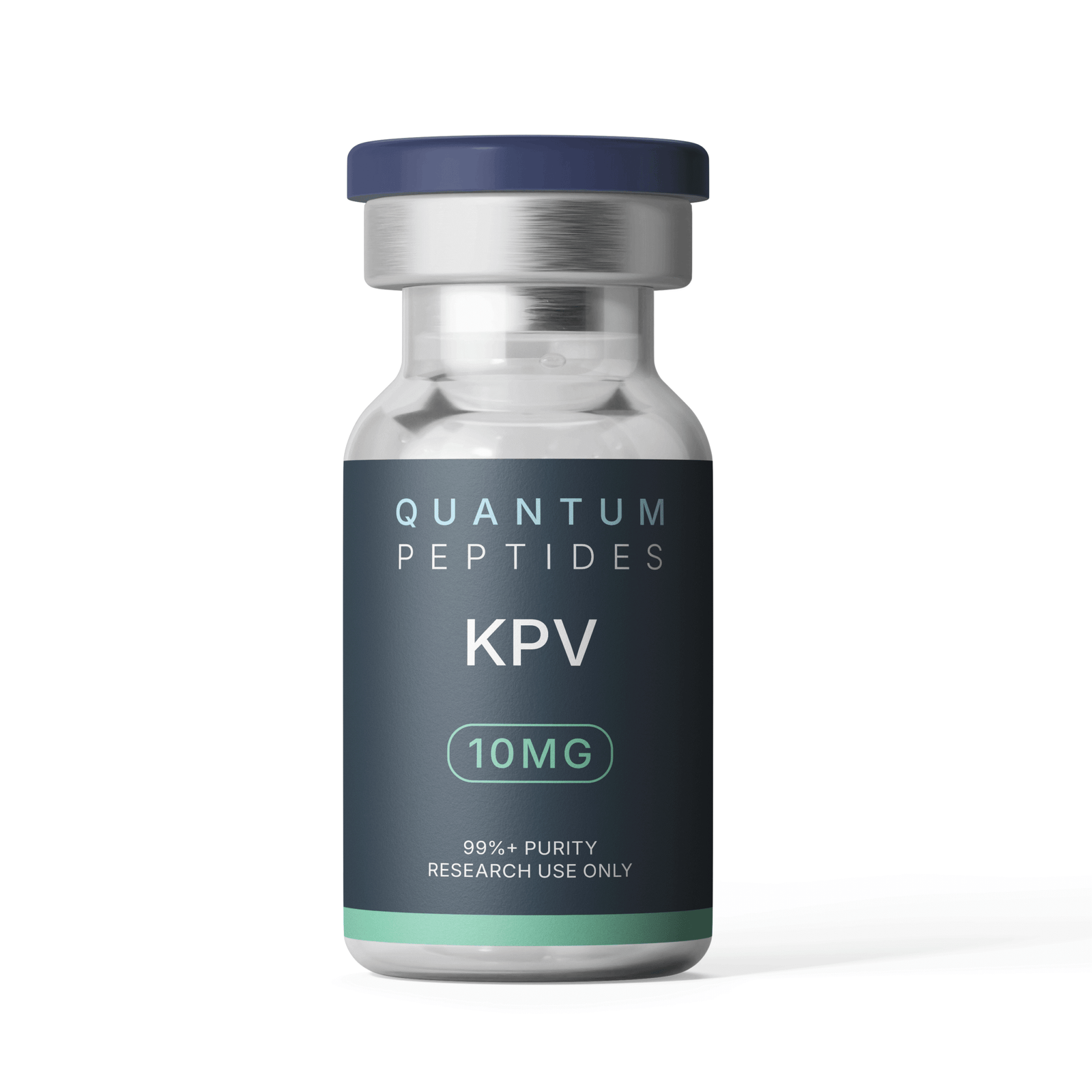
KPV is the tripeptide Lys-Pro-Val, the three C-terminal residues (11–13) of α-melanocyte-stimulating hormone (α-MSH). It was identified in the late 1980s as the shortest fragment of α-MSH that retained the parent hormone’s activity in inflammation models, and it has since been studied as a minimal, receptor-independent anti-inflammatory peptide in cell culture and in rodent models of colitis, dermatitis and lung inflammation. It is supplied here as a lyophilised powder for in-vitro and preclinical laboratory use.
Research background
The parent hormone, α-MSH, has long been known to dampen inflammatory signalling through melanocortin receptors. Work led by James Lipton and Anna Catania in the late 1980s and 1990s showed that the activity survived truncation to the C-terminal tripeptide KPV, which has negligible affinity for melanocortin receptors, implying a mechanism that does not depend on them. The best-known modern study is Dalmasso and colleagues (Gastroenterology, 2008), who reported that KPV is transported into intestinal epithelial and immune cells by the oligopeptide transporter PepT1, inhibits NF-κB activation and pro-inflammatory cytokine production in vitro, and reduces disease activity in two mouse colitis models when given orally in drinking water. Later papers from the Merlin laboratory and others have examined KPV delivered orally in nanoparticles or hydrogels, again in mouse colitis, and KPV in cultured keratinocytes and in mouse models of allergic airway and skin inflammation.
The literature is almost entirely preclinical. KPV has not been through a clinical development programme, and no controlled human efficacy or safety data exist for the research reagent. Several of the mechanistic claims, in particular the PepT1-dependence and the proposed intracellular targets, rest on a small number of laboratories and would benefit from independent replication.
Specifications
| Sequence | Lys-Pro-Val (KPV); α-MSH residues 11–13 |
| Also known as | Lysine-proline-valine, α-MSH(11–13), KPV tripeptide |
| CAS number | 67727-97-3 |
| Molecular formula | C16H30N4O4 |
| Molecular weight | C₁₆H₃₀N₄O₄ · 342.4 g/mol |
| Purity (HPLC) | Specification ≥ 99%; batch certificate not yet available (product is backordered) |
| Form | Lyophilised powder, 10 mg |
| Solubility | Water, bacteriostatic water, PBS |
| Storage (lyophilised) | −20 °C, desiccated, protected from light |
Mechanism of action (proposed)
Two features distinguish KPV from its parent hormone. First, it does not act through melanocortin receptors: its affinity for MC1R and the other melanocortin receptors is negligible, so the receptor-mediated model that explains α-MSH does not apply. Second, it is small and polar enough to be carried into cells by the proton-coupled oligopeptide transporter PepT1 (SLC15A1), which is expressed on intestinal epithelium and is induced on immune cells during inflammation. Inside the cell, KPV has been reported to prevent NF-κB nuclear translocation and to reduce transcription of IL-6, IL-8, TNF-α and related mediators. Whether it binds a specific intracellular target, interferes with IκB kinase signalling, or acts through another route is not established; the PepT1-uptake-then-NF-κB-inhibition model is the working hypothesis most papers adopt. A minority of studies describe additional, receptor-independent effects on keratinocytes and mast cells.
Research findings and limitations
Reported findings: reduced cytokine secretion and NF-κB activity in intestinal epithelial and T-cell lines (in vitro); reduced weight loss, colon shortening and histological damage in dextran-sulfate and trinitrobenzene-sulfonic-acid colitis in mice given KPV orally (in vivo, animal); similar effects with KPV loaded into oral nanoparticles or hydrogel; reduced inflammatory readouts in mouse models of allergic airway disease and contact dermatitis. Limitations: entirely preclinical; several findings come from a small group of laboratories; oral delivery results depend on a transporter whose expression differs between species and between healthy and inflamed tissue; no human data. A research supplier can confirm identity and purity; it cannot characterise effects in people, and this product is not for human or veterinary use.
Certificate of analysis
This product is currently backordered and no batch has been released for sale, so there is no batch-specific certificate of analysis yet. Quantum Peptides does not publish a certificate until an independent US laboratory has tested the exact lot that will ship. When stock is released, the lot number, measured purity and certificate link will appear in the product details above, as they do on our in-stock products. New to reading one? How to read a peptide certificate of analysis.
Handling and storage
Store the lyophilised powder at −20 °C, sealed and protected from light, and bring the vial to room temperature before opening. KPV has no cysteine, methionine or tryptophan, so it is not oxidation- or light-sensitive, and as a three-residue peptide it is chemically robust in solution; the usual precautions still apply. Keep reconstituted solution at 2–8 °C in the dark. See how to reconstitute a lyophilised peptide, bacteriostatic water vs sterile water and peptide storage and shelf life.
Reconstituting KPV
KPV dissolves readily in water or PBS. As an example of the arithmetic, 10 mg reconstituted with 2 mL gives 5 mg/mL, which is 14.6 mM for a 342.4 g/mol peptide. Use the peptide calculator for any other diluent volume or quantity per draw. Add diluent slowly down the inside of the vial and swirl; do not shake.
Related research compounds
KPV is the C-terminal fragment of α-MSH; the catalogue’s two cyclic α-MSH analogues, Melanotan II and PT-141, act through the melanocortin receptors that KPV does not, and the differences are explained in Melanotan II vs PT-141. KPV is also one of the four components of the “KLOW” blend discussed in the research community alongside GHK-Cu, BPC-157 and TB-500; see peptide blends in research.
Frequently asked questions
Is a certificate of analysis available for this product?
Not yet. The product is backordered and no batch has been released. A batch-specific certificate from an independent US laboratory will be linked on this page before any stock ships.
What is KPV?
The tripeptide Lys-Pro-Val, residues 11–13 of α-melanocyte-stimulating hormone, studied as a minimal anti-inflammatory fragment of the hormone in cell and mouse models.
What is the CAS number and molecular weight of KPV?
CAS 67727-97-3; C₁₆H₃₀N₄O₄, about 342.4 g/mol.
Does KPV act on melanocortin receptors?
No, or only negligibly. Its reported effects are receptor-independent; the leading hypothesis is cellular uptake through the PepT1 transporter followed by inhibition of NF-κB signalling.
Is KPV stable in solution?
Yes, comparatively: it has no oxidation-prone or light-sensitive residues. Standard cold, dark storage of solutions still applies.
How should the lyophilised powder be stored?
At −20 °C, sealed, desiccated and protected from light. Bring to room temperature before opening.
Can this product be used in humans or animals?
No. Quantum Peptides products are supplied for in-vitro and preclinical laboratory research only, not for human or veterinary use.
References
- Hiltz ME, Lipton JM. Antiinflammatory activity of a COOH-terminal fragment of the neuropeptide α-MSH. FASEB Journal. 1989.
- Dalmasso G, Charrier-Hisamuddin L, Nguyen HTT, et al. PepT1-mediated tripeptide KPV uptake reduces intestinal inflammation. Gastroenterology. 2008.
- Catania A, Lonati C, Sordi A, Carlin A, Leonardi P, Gatti S. The melanocortin system in control of inflammation. Scientific World Journal. 2010.
- Xiao B, Xu Z, Viennois E, et al. Orally targeted delivery of tripeptide KPV via hyaluronic acid-functionalized nanoparticles efficiently alleviates ulcerative colitis. Molecular Therapy. 2017.
Research use only. All products are supplied for in-vitro and preclinical laboratory research only. Not for human or veterinary use, not for diagnostic or therapeutic use. Purchaser must be 21+ and accept the Research Use Acknowledgement.