
Overview
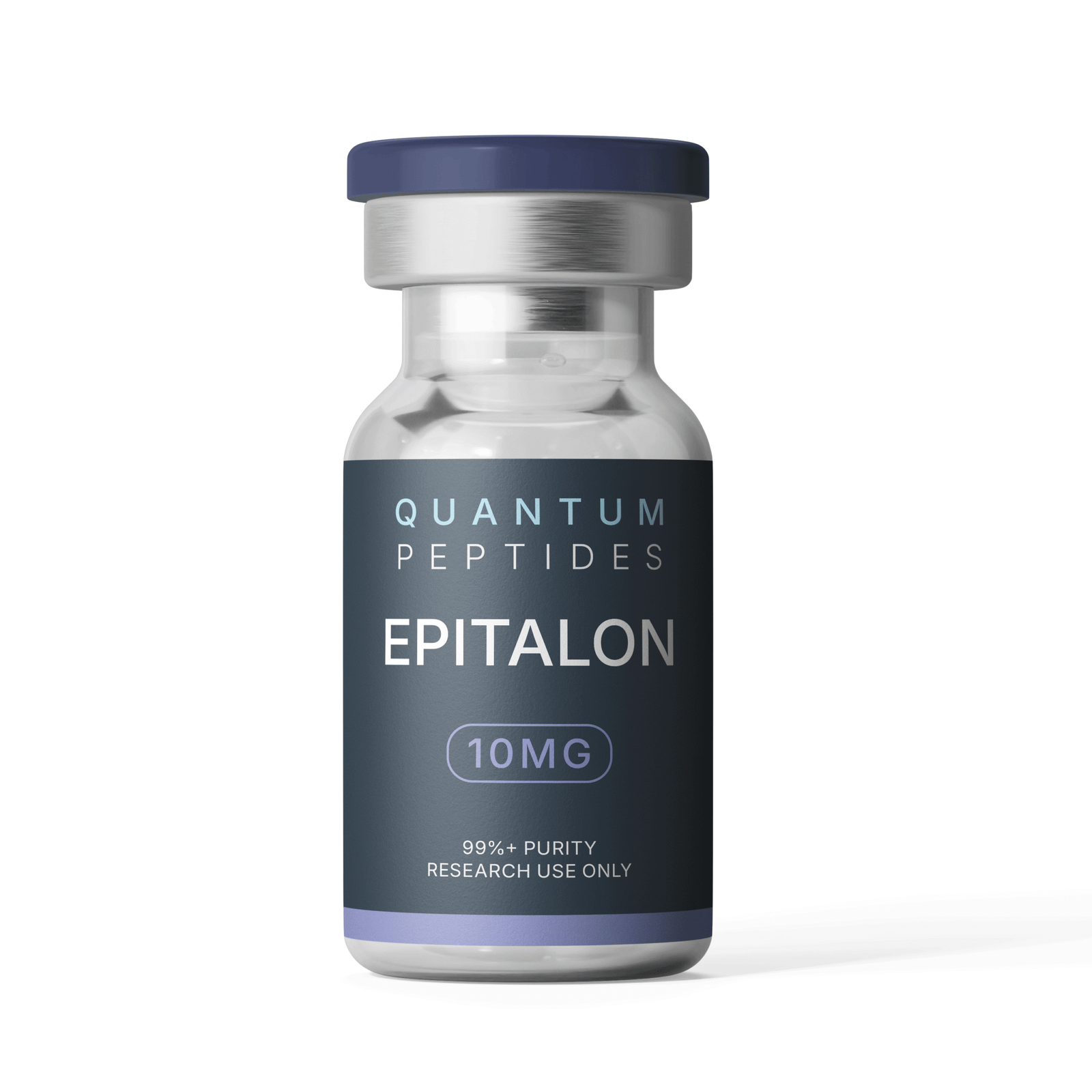
Epitalon (also written Epithalon or Epithalone) is a synthetic tetrapeptide, sequence Ala-Glu-Asp-Gly (AEDG), designed in the 1990s at the St Petersburg Institute of Bioregulation and Gerontology as a defined analogue of epithalamin, a polypeptide extract of the bovine pineal gland. It is one of the shortest peptides in the research catalogue and one of the most discussed in the ageing-biology literature, almost all of it from the laboratory that created it. It is supplied here as a lyophilised powder for in-vitro and preclinical laboratory use.
Research background
Epitalon’s history runs through the work of Vladimir Khavinson and colleagues, who moved from pineal extracts (epithalamin) to a four-residue synthetic peptide chosen to reproduce the extract’s activity in a defined molecule. The published programme covers three decades: in-vitro studies in human fibroblast cultures, ageing and tumour-incidence studies in rodents and Drosophila, melatonin and circadian studies in aged rhesus monkeys and rats, retinal-degeneration models, and gene-expression work in cultured cells. The best-known result is the 2003 report that AEDG induced telomerase activity and elongated telomeres in human somatic fibroblast cultures, extending the number of divisions before senescence. Later studies from the same group reported reduced spontaneous tumour incidence and modest lifespan effects in treated mice and rats, normalised night-time melatonin in aged primates, and altered expression of genes associated with neuronal differentiation in cultured cells.
The limitation researchers should weigh is concentration of evidence: the overwhelming majority of the Epitalon literature comes from one research institute and its collaborators, much of it in Russian-language journals or short reports, and independent replication of the central telomerase finding is sparse. Human reports exist (elderly cohorts receiving epithalamin or Epitalon in Russian geriatric settings), but they are small, largely uncontrolled, and concern pharmaceutical preparations rather than a research reagent. There is no controlled human efficacy or safety data for Epitalon as supplied for research.
Specifications
| Sequence | Ala-Glu-Asp-Gly (AEDG) |
| Also known as | Epithalon, Epithalone, epitalon tetrapeptide, AEDG peptide |
| CAS number | 307297-39-8 |
| Molecular formula | C14H22N4O9 |
| Molecular weight | C₁₄H₂₂N₄O₉ · 390.3 g/mol |
| Purity (HPLC) | Specification ≥ 99%; batch certificate not yet available (product is backordered) |
| Form | Lyophilised powder, 10 mg |
| Solubility | Water, bacteriostatic water |
| Storage (lyophilised) | −20 °C, desiccated, protected from light |
Mechanism of action (proposed)
No mechanism for Epitalon is established beyond doubt; the following are the hypotheses the literature advances. The originating group proposes that short peptides of this kind enter cells and the nucleus and bind directly to DNA at specific promoter sequences, altering transcription; for AEDG the proposed consequence is induction of telomerase reverse transcriptase (hTERT) expression, which would account for the telomerase activity and telomere elongation reported in fibroblast cultures. A second strand of work attributes the circadian findings to restored pineal melatonin synthesis in aged animals. Molecular-modelling papers describe possible AEDG–DNA interactions, but direct biophysical confirmation in living cells is limited. Researchers should treat the DNA-binding model as a working hypothesis from a single group rather than a settled pathway.
Research findings and limitations
In summary, the reported findings are: telomerase activation and telomere elongation in cultured human fibroblasts (in vitro); increased replicative capacity of those cultures; reduced tumour incidence and modest mean-lifespan changes in treated rodents and fruit flies (in vivo, animal); normalisation of melatonin rhythm in aged monkeys; protective effects in rat retinal-degeneration models; and changes in neurogenic gene expression in cell culture. Against these: single-source literature, small animal groups, limited independent replication, and no controlled human data. A research supplier can confirm the identity and purity of the peptide; it cannot tell you what the peptide does in a person, and this product is not for human or veterinary use.
Certificate of analysis
This product is currently backordered and no batch has been released for sale, so there is no batch-specific certificate of analysis yet. Quantum Peptides does not publish a certificate until an independent US laboratory has tested the exact lot that will ship. When stock is released, the lot number, measured purity and certificate link will appear in the product details above, as they do on our in-stock products. New to reading one? How to read a peptide certificate of analysis.
Handling and storage
Store the lyophilised powder at −20 °C, sealed and protected from light, and bring the vial to room temperature before opening. AEDG contains no cysteine or methionine, so it is not oxidation-prone, but the Asp-Gly linkage can isomerise slowly in solution; keep reconstituted solution at 2–8 °C in the dark and prepare fresh for sensitive assays. See how to reconstitute a lyophilised peptide, bacteriostatic water vs sterile water and peptide storage and shelf life.
Reconstituting Epitalon
Epitalon dissolves readily in water. As an example of the arithmetic, 10 mg reconstituted with 2 mL gives 5 mg/mL, which is 12.8 mM for a 390.3 g/mol peptide. Use the peptide calculator for any other diluent volume or quantity per draw. Add diluent slowly down the inside of the vial and swirl; do not shake.
Related research compounds
Other short peptides in the catalogue studied in cell-signalling and ageing models include GHK-Cu (a copper tripeptide) and MOTS-c (a mitochondrial-encoded peptide); the catalogue overview of lyophilised powders lists all current vials. Background on how purity and identity are verified is in peptide purity explained.
Frequently asked questions
Is a certificate of analysis available for this product?
Not yet. The product is backordered and no batch has been released. A batch-specific certificate from an independent US laboratory will be linked on this page before any stock ships.
What is the sequence and molecular weight of Epitalon?
Ala-Glu-Asp-Gly (AEDG); C₁₄H₂₂N₄O₉, about 390.3 g/mol.
What is the CAS number of Epitalon?
307297-39-8.
Is Epitalon the same as epithalamin?
No. Epithalamin is a polypeptide extract of the pineal gland; Epitalon is a defined synthetic tetrapeptide designed to reproduce its activity in a single molecule.
Has Epitalon been shown to activate telomerase?
In cultured human fibroblasts, yes, in a 2003 report from the originating laboratory. The finding has limited independent replication and has not been demonstrated in humans.
Is Epitalon stable in solution?
Reasonably: it has no oxidation-prone residues. Aspartate-glycine isomerisation is the slow degradation route, so keep solutions cold and dark and prepare fresh for sensitive work.
How should the lyophilised powder be stored?
At −20 °C, sealed, desiccated and protected from light. Bring to room temperature before opening.
Can this product be used in humans or animals?
No. Quantum Peptides products are supplied for in-vitro and preclinical laboratory research only, not for human or veterinary use.
References
- Khavinson VKh, Bondarev IE, Butyugov AA. Epithalon peptide induces telomerase activity and telomere elongation in human somatic cells. Bulletin of Experimental Biology and Medicine. 2003.
- Anisimov VN, Khavinson VKh, Popovich IG, et al. Effect of Epitalon on biomarkers of aging, life span and spontaneous tumor incidence in female Swiss-derived SHR mice. Biogerontology. 2003.
- Khavinson VKh, Lezhava TA, Monaselidze JR, et al. Peptide Epitalon activates chromatin at the old age. Neuro Endocrinology Letters. 2003.
- Goncharova ND, Vengerin AA, Khavinson VKh, Lapin BA. Pineal peptides restore the age-related disturbances in hormonal functions of the pineal gland and the pancreas. Experimental Gerontology. 2005.
- Khavinson VKh, Linkova NS, Tarnovskaya SI. Short peptides regulate gene expression. Bulletin of Experimental Biology and Medicine. 2016.
Research use only. All products are supplied for in-vitro and preclinical laboratory research only. Not for human or veterinary use, not for diagnostic or therapeutic use. Purchaser must be 21+ and accept the Research Use Acknowledgement.