
Peptide vs protein vs amino acid: where the lines are drawn
An amino acid is a single building block. A peptide is a short chain of amino acids. A protein is a long chain, or several chains, folded into a stable three-dimensional shape. The chemistry joining them is identical. What changes is length, and with length, behavior.
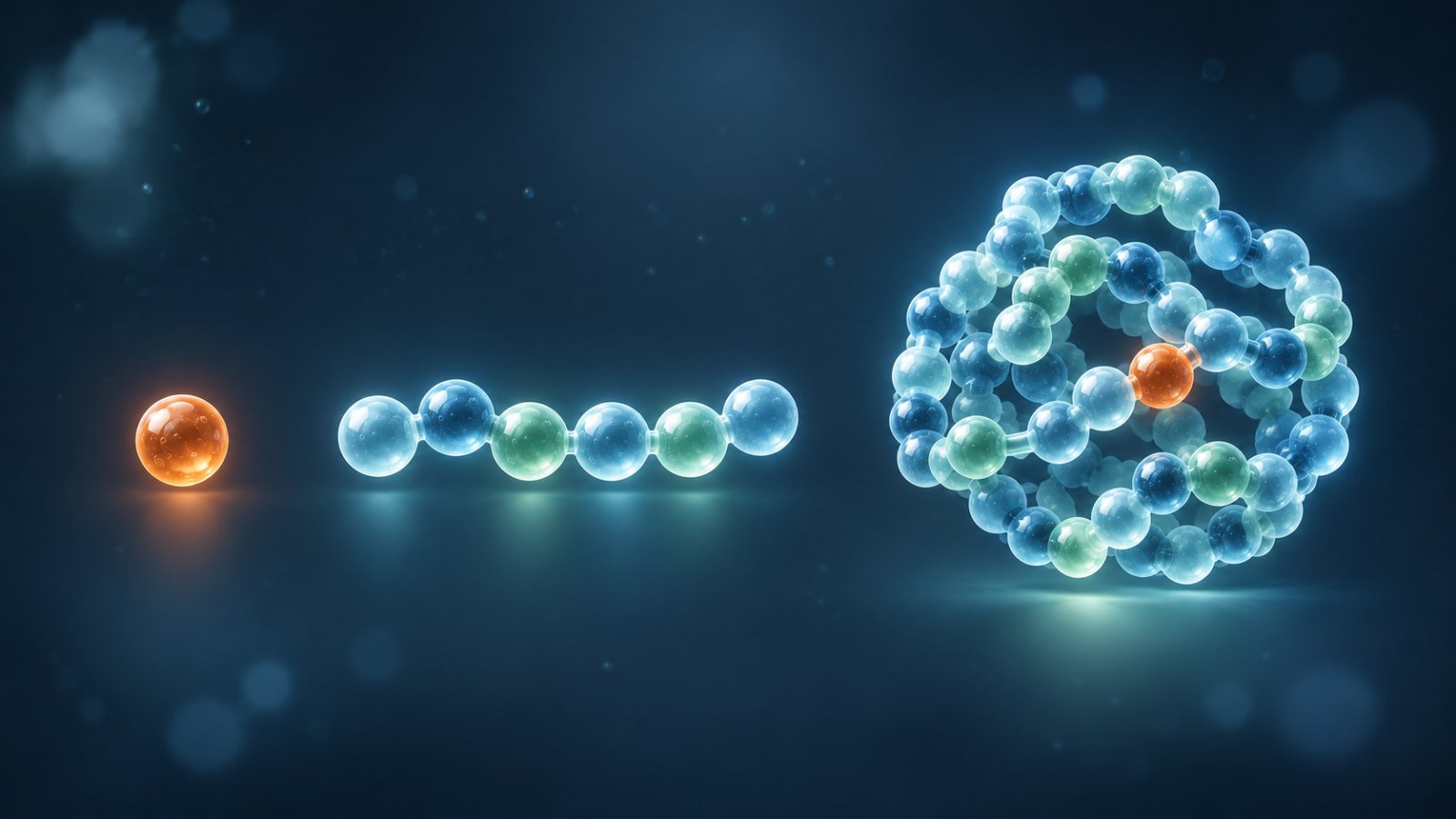
This guide defines the three terms, shows where the usual cut-offs sit and why they disagree, and explains what the difference means when the material is on a laboratory bench. For laboratory research use only.
The three terms side by side
| Attribute | Amino acid | Peptide | Protein |
|---|---|---|---|
| What it is | One molecule with an amino group and a carboxyl group | A chain of amino acids joined by peptide bonds | One or more long chains folded into a defined structure |
| Typical length | 1 | 2 to about 50 | More than about 50 |
| Typical mass | 75 to 204 Da | About 130 Da to 5,500 Da | About 5,500 Da to several million Da |
| Example | Glycine (75 Da) | BPC-157 (15 residues, 1,419.5 Da) | Serum albumin (585 residues, about 66,500 Da) |
| How it is usually made for research | Fermentation or chemical synthesis | Chemical synthesis on a solid support | Expression in engineered cells |
Amino acids
Twenty amino acids are specified by the standard genetic code. They share a common backbone and differ in the side chain attached to it, which may be acidic, basic, polar or oily. Once an amino acid is built into a chain it has lost a molecule of water and is called a residue. The average residue weighs about 110 Da, which gives a quick estimate of the size of any chain from its length.
Peptides
Two amino acids joined by a peptide bond make a dipeptide, three a tripeptide. Short chains are called oligopeptides and longer ones polypeptides. Peptides are usually flexible in solution and do not hold a single fixed shape, although some are locked into a ring: PT-141 and Melanotan II are both cyclic heptapeptides. An introduction to the class is in what are peptides.
Proteins
A protein is a polypeptide long enough to fold. Its chain packs into helices and sheets, and those pack into a stable three-dimensional structure on which its function depends. Many proteins are assemblies of several chains. The largest known human protein, titin, is a single chain of roughly 34,000 residues. Heat, extreme pH or drying can unfold a protein and destroy its activity, which is called denaturation.
Where is the line between a peptide and a protein?
There is no sharp one. Three conventions are in common use:
- About 50 residues. The textbook convention, and the one most chemists use.
- 40 residues. The definition the US Food and Drug Administration adopted in 2020, under which a protein is an amino acid polymer with a defined sequence of more than 40 amino acids.
- Folding. The structural biologist’s test: a protein has a stable folded structure, a peptide generally does not.
The conventions disagree in the middle. Thymosin β4 has 43 residues and tesamorelin has 44. Both are peptides by the 50-residue convention and above the 40-residue line. Insulin, at 51 residues in two chains, is called a peptide hormone by physiologists and a small protein by chemists. None of this changes what the molecules are.
Why the difference matters in the laboratory
- Manufacture. Peptides are built chemically, one residue at a time, which becomes inefficient as chains lengthen. Proteins are produced by cells. See how research peptides are made.
- Identity testing. A peptide’s exact mass can be calculated from its sequence and confirmed by mass spectrometry to within a fraction of a dalton. See peptide sequence and molecular weight.
- Stability. Most peptides have no folded structure to lose, so they tolerate freeze-drying well. That is why they are supplied lyophilized.
Is everything in a peptide catalog a peptide?
No. A catalog of research peptides typically mixes several classes of compound:
| Compound | Class | Length |
|---|---|---|
| KPV | Peptide | 3 residues |
| Glutathione | Peptide with one unusual (γ-glutamyl) bond | 3 residues |
| GHK-Cu | Peptide bound to a copper(II) ion | 3 residues |
| Epitalon | Peptide | 4 residues |
| PT-141, Melanotan II | Cyclic peptides | 7 residues |
| BPC-157 | Peptide | 15 residues |
| MOTS-c | Peptide | 16 residues |
| TB-500 (thymosin β4) | Peptide, near the protein boundary | 43 residues |
| Tesamorelin | Modified peptide, near the protein boundary | 44 residues |
| Dihexa | Peptidomimetic: a capped, modified dipeptide (Tyr-Ile core) | Not applicable |
| NAD+ | Dinucleotide coenzyme, not a peptide | Not applicable |
| SLU-PP-332 | Small synthetic molecule, not a peptide | Not applicable |
Frequently asked questions
What is the difference between a peptide and a protein?
Length and folding. Peptides are chains of up to about 50 amino acids and are usually flexible. Proteins are longer and fold into a stable structure.
What is the difference between an amino acid and a peptide?
An amino acid is a single molecule. A peptide is two or more amino acids joined by peptide bonds.
How many amino acids make a protein?
By the usual convention, more than about 50. The US Food and Drug Administration uses more than 40.
Is insulin a peptide or a protein?
Both terms are used. It has 51 amino acids in two chains, which places it just over the conventional boundary.
Is a polypeptide the same as a protein?
Not quite. A polypeptide is any long chain of amino acids. A protein is one or more polypeptides folded into a working structure.
References
- IUPAC-IUB Joint Commission on Biochemical Nomenclature. Nomenclature and symbolism for amino acids and peptides. European Journal of Biochemistry. 1984. PMID 6692818
- US Food and Drug Administration. Definition of the term “biological product”; final rule. Federal Register. 2020. Federal Register 2020-03505
- Nelson DL, Cox MM. Lehninger Principles of Biochemistry. W. H. Freeman.
- Bang ML, Centner T, Fornoff F, et al. The complete gene sequence of titin, expression of an unusual approximately 700-kDa titin isoform, and its interaction with obscurin identify a novel Z-line to I-band linking system. Circulation Research. 2001. PMID 11717165
Quantum Peptides supplies lyophilized research peptides for in-vitro and preclinical laboratory research only. Products are not for human or veterinary use. This guide summarizes published literature and is not guidance on administration of any kind.