
What are peptides? A plain guide to peptides and research peptides
A peptide is a short chain of amino acids joined end to end by peptide bonds. Peptides are made by every living cell, they range from two amino acids to a few dozen, and many of the body’s signaling molecules are peptides. A research peptide is one made by chemical synthesis and supplied as a laboratory reagent.
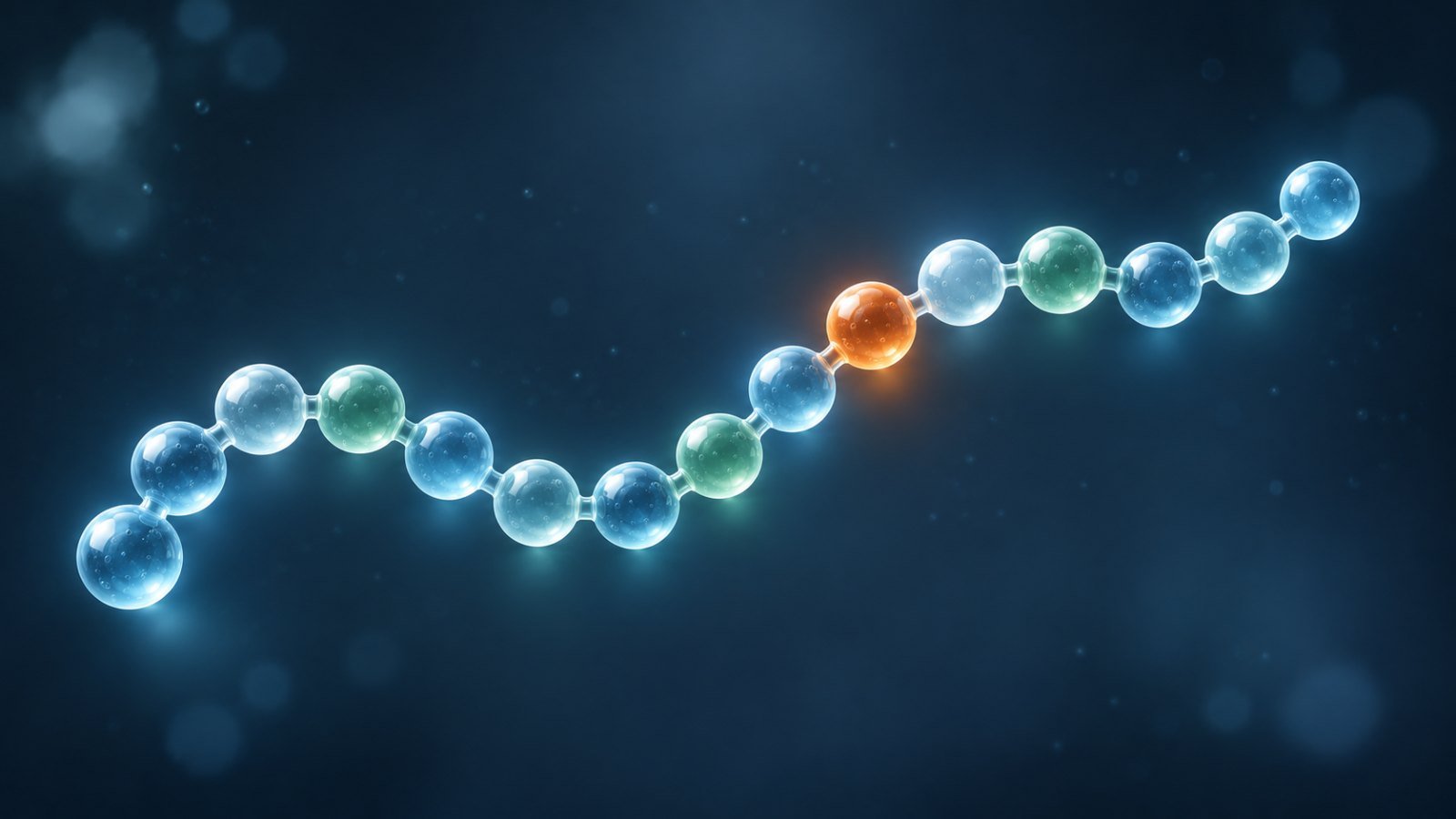
This guide explains what peptides are, where they occur, how they are named, and what the term “research peptides” does and does not mean. For laboratory research use only.
What is a peptide?
Amino acids are small molecules with an amino group at one end and a carboxyl group at the other. When the carboxyl group of one reacts with the amino group of the next, a molecule of water is lost and a peptide bond forms. Repeat that and the result is a chain with a defined order, its sequence. The sequence is what makes one peptide different from another.
By convention, chains of up to about 50 amino acids are called peptides and longer, folded chains are called proteins. The boundary is a convention, not a law of nature, and different fields draw it in different places. Where the lines fall is covered in peptide vs protein vs amino acid.
Peptides by size
| Peptide | Length | What it is |
|---|---|---|
| Glutathione | 3 amino acids | The most abundant low-molecular-weight thiol in cells |
| Oxytocin | 9 amino acids | A pituitary hormone; the first peptide hormone to be synthesized, in 1953 |
| BPC-157 | 15 amino acids | A synthetic peptide studied in rodent tissue models |
| MOTS-c | 16 amino acids | A peptide encoded in mitochondrial DNA |
| Glucagon | 29 amino acids | A pancreatic hormone |
| Thymosin β4 | 43 amino acids | An actin-binding peptide found in most cells |
| Insulin | 51 amino acids in two chains | A pancreatic hormone, usually classed as a small protein |
Where peptides occur
Cells make peptides in two ways. Most are cut from larger precursor proteins by enzymes: α-MSH, for example, is cut from pro-opiomelanocortin. A few, such as glutathione, are assembled by dedicated enzymes without a ribosome. Peptides act as hormones, as neurotransmitters, as antimicrobial defenses and as signals between neighboring cells. Signaling peptides generally work by binding a receptor on a cell surface, and they are usually short-lived, because enzymes called peptidases break them down, often within minutes.
How peptides are named and written
A peptide is written from its free amino end (the N-terminus) to its free carboxyl end (the C-terminus), using three-letter or one-letter codes for each amino acid. KPV is Lys-Pro-Val. Names such as BPC-157 or MOTS-c are laboratory or trade names and say nothing about the structure. The sequence and the molecular weight calculated from it are what identify a peptide, as explained in peptide sequence and molecular weight.
What are research peptides?
“Research peptides” is a market term, not a chemical class. It means synthetic peptides sold as reagents for laboratory work: cell culture, assay development, analytical standards and preclinical studies. They are made by solid-phase peptide synthesis, purified, and supplied lyophilized in sealed vials.
Three things follow from that:
- They are not medicines. More than 80 peptide drugs have reached the market since insulin in the 1920s, each one manufactured and approved under pharmaceutical regulation. A research peptide has not been through that process, whatever its sequence.
- They are not supplements or cosmetics. “Collagen peptides” in food products are mixtures of fragments made by breaking down a protein. A research peptide is a single defined sequence.
- Identity and purity rest on the certificate. A research peptide is only as well characterized as the testing behind the lot. See how to read a peptide certificate of analysis and peptide purity explained.
Not everything sold alongside peptides is a peptide
Catalogs of research peptides usually include compounds that are not peptides at all. NAD+ is a dinucleotide coenzyme. SLU-PP-332 is a small synthetic molecule. GHK-Cu is a peptide bound to a copper ion. The distinction matters in the laboratory, because it decides how a compound dissolves, how it is tested and how stable it is. Each compound’s own overview in the Learn library states what it is.
Frequently asked questions
What are peptides made of?
Amino acids, joined in a chain by peptide bonds. The order of the amino acids is the peptide’s sequence.
Are peptides proteins?
They are built the same way, but peptides are shorter. Chains of up to about 50 amino acids are usually called peptides; longer, folded chains are proteins.
Are peptides steroids?
No. Steroids are lipids built on a four-ring carbon skeleton derived from cholesterol. Peptides are chains of amino acids. The two classes are chemically unrelated.
How are research peptides made?
By solid-phase peptide synthesis, one amino acid at a time on a resin bead, followed by purification and freeze-drying.
What does “research use only” mean?
That a product is supplied as a laboratory reagent for in-vitro and preclinical work, and not for human or veterinary use. See our research use acknowledgement.
References
- IUPAC-IUB Joint Commission on Biochemical Nomenclature. Nomenclature and symbolism for amino acids and peptides. European Journal of Biochemistry. 1984. PMID 6692818
- du Vigneaud V, Ressler C, Swan JM, et al. The synthesis of an octapeptide amide with the hormonal activity of oxytocin. Journal of the American Chemical Society. 1953. DOI 10.1021/ja01115a553
- Merrifield RB. Solid phase peptide synthesis. I. The synthesis of a tetrapeptide. Journal of the American Chemical Society. 1963. DOI 10.1021/ja00897a025
- Lau JL, Dunn MK. Therapeutic peptides: historical perspectives, current development trends, and future directions. Bioorganic & Medicinal Chemistry. 2018. PMID 28720325
- Muttenthaler M, King GF, Adams DJ, Alewood PF. Trends in peptide drug discovery. Nature Reviews Drug Discovery. 2021. PMID 33536635
Quantum Peptides supplies lyophilized research peptides for in-vitro and preclinical laboratory research only. Products are not for human or veterinary use. This guide summarizes published literature and is not guidance on administration of any kind.