Overview
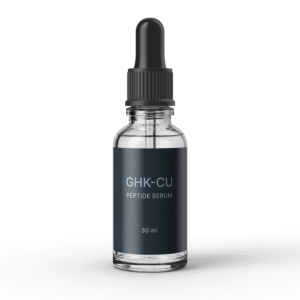
GHK-Cu is the copper(II) complex of the tripeptide glycyl-L-histidyl-L-lysine. The tripeptide was first isolated from human plasma by Loren Pickart in 1973; its affinity for copper gives the complex its characteristic blue colour. Supplied as a lyophilised powder for in-vitro and preclinical research.
Research background
GHK-Cu is among the best-characterised peptides in dermatological and connective-tissue research. Published work examines its effects on fibroblast collagen and glycosaminoglycan synthesis in culture, modulation of matrix metalloproteinases and their inhibitors, and — in a 2012 gene-expression analysis — altered expression of a large fraction of human genes in vitro. It is also used as a reference compound in copper-chelation and wound-model assays. Most data are in-vitro or animal; the peptide is additionally used in cosmetic formulations, which is a separate regulatory category from this product.
Specifications
| Sequence | Gly-His-Lys · Cu(II) |
| Molecular weight | ≈ 403.9 g/mol (complex); 340.4 g/mol (free peptide) |
| Purity (HPLC) | ≥ 99% — see lot certificate |
| Form | Lyophilised powder, 50 mg |
| Appearance | Blue to blue-violet powder |
| Solubility | Water |
| Storage (lyophilised) | −20 °C, desiccated, protected from light |
Certificate of analysis
Every lot is tested by an independent US laboratory. The certificate for the lot you receive is linked in the product details above and carries the same lot number as the vial label. New to reading one? How to read a peptide certificate of analysis.
Handling and storage
Store the lyophilised powder at −20 °C, sealed and protected from light, and bring the vial to room temperature before opening. After reconstitution keep the solution at 2–8 °C in the dark. See how to reconstitute a lyophilised peptide (with calculator) and peptide storage and shelf life.
Frequently asked questions
Is the copper already complexed?
Yes. The product is supplied as the GHK copper(II) complex, not as the free tripeptide plus a separate copper salt.
Why does the solution look blue?
The colour is the copper(II) complex itself. A colour change toward green or brown, or precipitate, indicates a problem.
How stable is GHK-Cu in solution?
More stable than most peptides because of its short length, but copper can catalyse oxidation of other compounds in the same solution. Store cold and dark.
Which certificate applies to my vial?
The lot certificate linked on this page; its lot number matches the label on the vial.
Research use only?
Yes. Not for human, veterinary or cosmetic use as supplied.
Research use only. All products are supplied for in-vitro and preclinical laboratory research only. Not for human or veterinary use, not for diagnostic or therapeutic use. Purchaser must be 21+ and accept the Research Use Acknowledgement.