
Overview
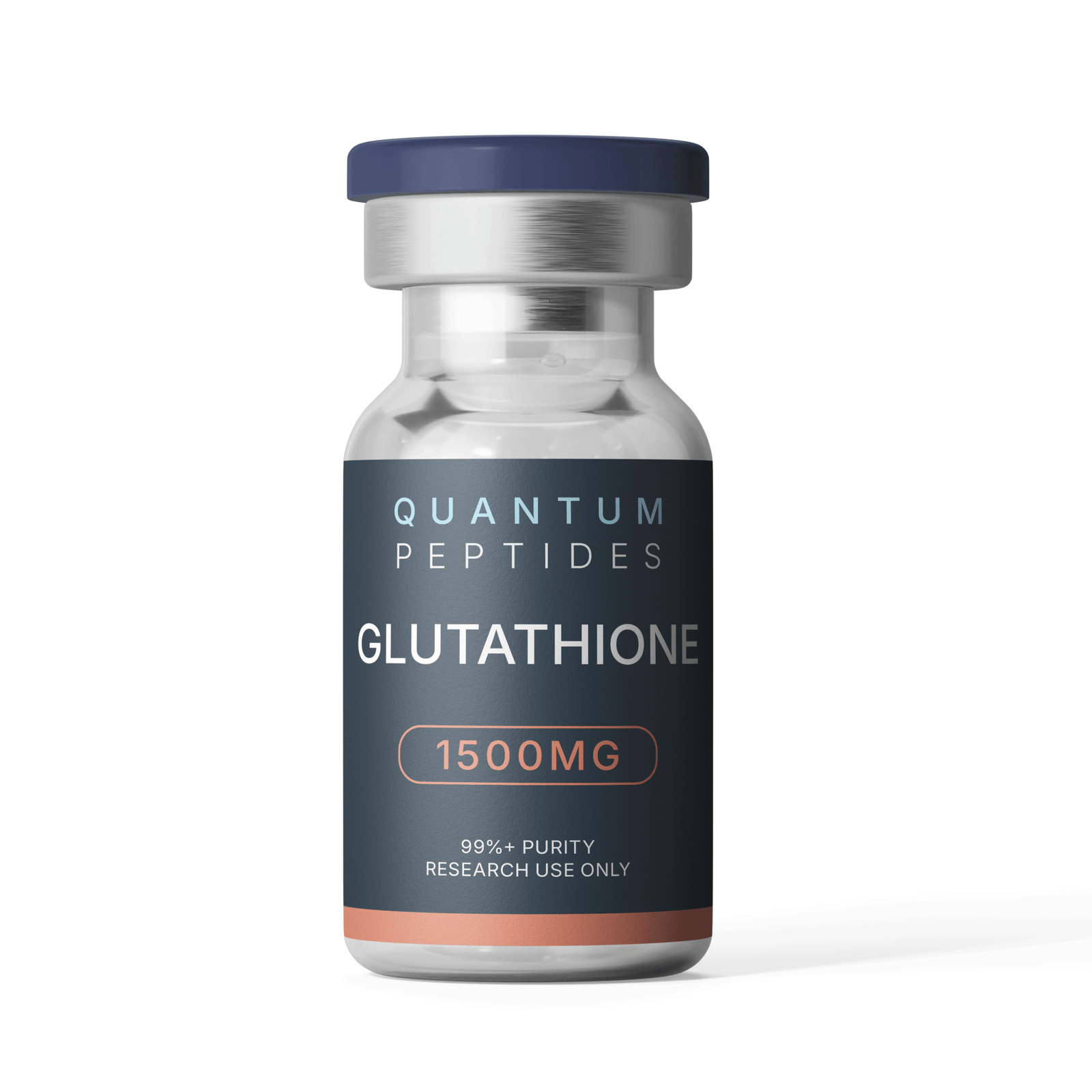
Glutathione (GSH) is the tripeptide γ-L-glutamyl-L-cysteinyl-glycine, the most abundant low-molecular-weight thiol in animal cells and the central small-molecule buffer of the cellular redox state. Unlike most peptides in the catalogue it is not a synthetic analogue of a hormone: it is a native metabolite present at millimolar concentration in essentially every cell, with an unusual γ-glutamyl linkage that protects it from ordinary peptidases. It is supplied here as the reduced form, 1,500 mg of lyophilised powder, for in-vitro and preclinical laboratory use.
Research background
Glutathione was described in 1888 and its structure settled in the 1920s and 1930s, with Hopkins and Kendall among the chemists who characterised it. Its biochemistry is textbook material: the glutathione peroxidase family uses GSH to reduce hydrogen peroxide and lipid hydroperoxides, glutathione reductase regenerates GSH from the oxidised disulfide (GSSG) at the expense of NADPH, and the glutathione S-transferases conjugate GSH to electrophiles for export and excretion. The GSH:GSSG ratio is therefore the standard readout of oxidative stress in cultured cells and tissue, and the rate-limiting synthetic enzyme, glutamate-cysteine ligase, is one of the best-studied targets of the Nrf2 antioxidant-response pathway. More recently the glutathione–GPX4 axis has been identified as the gatekeeper of ferroptosis, an iron-dependent form of regulated cell death, which has made GSH depletion and repletion a routine experimental manipulation in cancer-biology and neurodegeneration models.
As a research reagent, glutathione is used in three ways: as a supplement to culture media and buffers to hold a defined reducing environment; as an experimental variable, added or depleted (for example with buthionine sulfoximine) to probe oxidative-stress responses; and as a standard in GSH/GSSG assays. Human studies of oral, intravenous and inhaled glutathione exist in the nutritional and clinical literature, but they concern pharmaceutical or supplement preparations and have no bearing on a research reagent; this product is not for nutritional supplementation or clinical use.
Specifications
| Sequence | γ-L-Glu-L-Cys-Gly (γ-glutamyl linkage; reduced form, GSH) |
| Also known as | L-Glutathione reduced, GSH, γ-L-glutamyl-L-cysteinylglycine |
| CAS number | 70-18-8 |
| Molecular formula | C10H17N3O6S |
| Molecular weight | C₁₀H₁₇N₃O₆S · 307.3 g/mol |
| Purity (HPLC) | Specification ≥ 99%; batch certificate not yet available (product is backordered) |
| Form | Lyophilised powder, 1,500 mg |
| Solubility | Water, PBS (freely soluble) |
| Storage (lyophilised) | −20 °C, desiccated, protected from light and air |
Mechanism of action
Glutathione’s chemistry turns on the cysteine thiol. Two GSH molecules donate electrons and join through a disulfide bond to form GSSG; glutathione reductase splits GSSG back to two GSH using NADPH. Within that cycle, glutathione peroxidases (GPX1–GPX8) use GSH to reduce peroxides, GPX4 specifically reducing lipid hydroperoxides in membranes; glutathione S-transferases attach GSH to reactive electrophiles, including many xenobiotics and drug metabolites; and glutaredoxins use GSH to reverse protein S-glutathionylation, a reversible modification that regulates enzyme activity. GSH also directly scavenges radicals and forms adducts with reactive aldehydes. Because synthesis requires cysteine, which is usually limiting, and because GSH is exported and degraded by γ-glutamyl transpeptidase, cellular GSH turns over on a timescale of hours. These pathways are established biochemistry rather than hypotheses; what remains an active research question is how GSH compartmentalisation (cytosol, mitochondria, nucleus, endoplasmic reticulum) and transport contribute to specific disease models.
Research findings and limitations
Reported findings: GSH depletion sensitises cultured cells to oxidants, electrophiles and ferroptosis inducers, and repletion with GSH or its precursors reverses this (in vitro); GSH/GSSG ratios shift in rodent models of ischaemia–reperfusion, drug toxicity and ageing (in vivo, animal); exogenous GSH added to culture medium or perfusate protects cells and isolated organs in many models. Limitations: exogenous GSH crosses cell membranes poorly, so in most cell experiments its effect comes from extracellular reduction or from breakdown to cysteine and resynthesis inside the cell; it oxidises in aerobic buffers over hours, so results depend on how fresh the solution is; and human clinical and supplement data concern regulated preparations, not a research reagent. A research supplier can confirm identity and purity; it cannot characterise effects in people, and this product is not for human or veterinary use.
Certificate of analysis
This product is currently backordered and no batch has been released for sale, so there is no batch-specific certificate of analysis yet. Quantum Peptides does not publish a certificate until an independent US laboratory has tested the exact lot that will ship. When stock is released, the lot number, measured purity and certificate link will appear in the product details above, as they do on our in-stock products. For glutathione the certificate should also state that the material is the reduced form; a high GSSG content shows as a second HPLC peak. New to reading one? How to read a peptide certificate of analysis.
Handling and storage
Store the lyophilised powder at −20 °C, sealed, desiccated and protected from light, and bring the vial to room temperature before opening. The free thiol is the point of the molecule and also its weakness: in solution, especially at neutral or alkaline pH and in the presence of air or trace metals, GSH oxidises to GSSG within hours to days. Prepare solutions fresh on the day of use, keep them cold and capped, and consider degassing or adding a chelator (EDTA) for sensitive assays. Do not store aqueous stocks for more than a day at 2–8 °C; freeze single-use portions at −20 °C or below if a stock must be kept. See how to reconstitute a lyophilised peptide and peptide storage and shelf life.
Reconstituting glutathione
Glutathione dissolves readily in water or PBS and the solution is acidic (about pH 3 at high concentration), so buffer it if the assay requires neutral pH. As an example of the arithmetic, 1,500 mg in 10 mL gives 150 mg/mL, about 0.49 M; a 100 mM working stock is 30.7 mg/mL, so the full vial makes roughly 49 mL. Use the peptide calculator for any other volume or quantity per draw. Add diluent slowly down the inside of the vial and swirl; do not shake.
Related research compounds
Glutathione is often used alongside the catalogue’s other metabolic and signalling peptides, for example MOTS-c (mitochondrial-encoded peptide) and GHK-Cu, whose copper centre is itself redox-active and should not be mixed with GSH in the same solution without a reason. The full list of current vials is in lyophilised powders, and the background on how purity is verified is in peptide purity explained.
Frequently asked questions
Is a certificate of analysis available for this product?
Not yet. The product is backordered and no batch has been released. A batch-specific certificate from an independent US laboratory will be linked on this page before any stock ships.
Is this the reduced or oxidised form of glutathione?
Reduced (GSH, free thiol). The oxidised disulfide GSSG is a different compound with twice the molecular weight.
What is the CAS number and molecular weight of glutathione?
CAS 70-18-8; C₁₀H₁₇N₃O₆S, 307.3 g/mol.
Why is glutathione called a tripeptide when it resists peptidases?
Because the glutamate is joined through its side-chain γ-carboxyl rather than the usual α-carboxyl. Ordinary peptidases do not recognise this bond; only γ-glutamyl transpeptidase cleaves it.
How stable is glutathione in solution?
Poorly stable: the thiol oxidises to GSSG over hours at neutral pH in air. Prepare fresh, keep cold and capped, and freeze single-use portions if a stock must be stored.
How should the lyophilised powder be stored?
At −20 °C, sealed, desiccated and protected from light and air. Bring to room temperature before opening.
Why is this vial 1,500 mg rather than 10 mg?
Glutathione is used at millimolar concentrations in buffers and media, roughly a thousand times the concentrations typical for signalling peptides, so a research-scale quantity is correspondingly larger.
Can this product be used in humans or animals?
No. Quantum Peptides products are supplied for in-vitro and preclinical laboratory research only, not for human or veterinary use, and not as a nutritional supplement.
References
- Meister A, Anderson ME. Glutathione. Annual Review of Biochemistry. 1983.
- Forman HJ, Zhang H, Rinna A. Glutathione: overview of its protective roles, measurement, and biosynthesis. Molecular Aspects of Medicine. 2009.
- Lu SC. Glutathione synthesis. Biochimica et Biophysica Acta. 2013.
- Dixon SJ, Lemberg KM, Lamprecht MR, et al. Ferroptosis: an iron-dependent form of nonapoptotic cell death. Cell. 2012.
- Yang WS, SriRamaratnam R, Welsch ME, et al. Regulation of ferroptotic cancer cell death by GPX4. Cell. 2014.
Research use only. All products are supplied for in-vitro and preclinical laboratory research only. Not for human or veterinary use, not for diagnostic or therapeutic use. Purchaser must be 21+ and accept the Research Use Acknowledgement.