
Mitochondrial peptides in the research literature: MOTS-c, humanin and what counts as one
“Mitochondrial peptides” is used for three different things: peptides encoded in mitochondrial DNA, synthetic peptides designed to enter mitochondria, and compounds that are not peptides at all but are studied for their effect on mitochondrial function. Keeping the three apart is the first step in reading the literature.
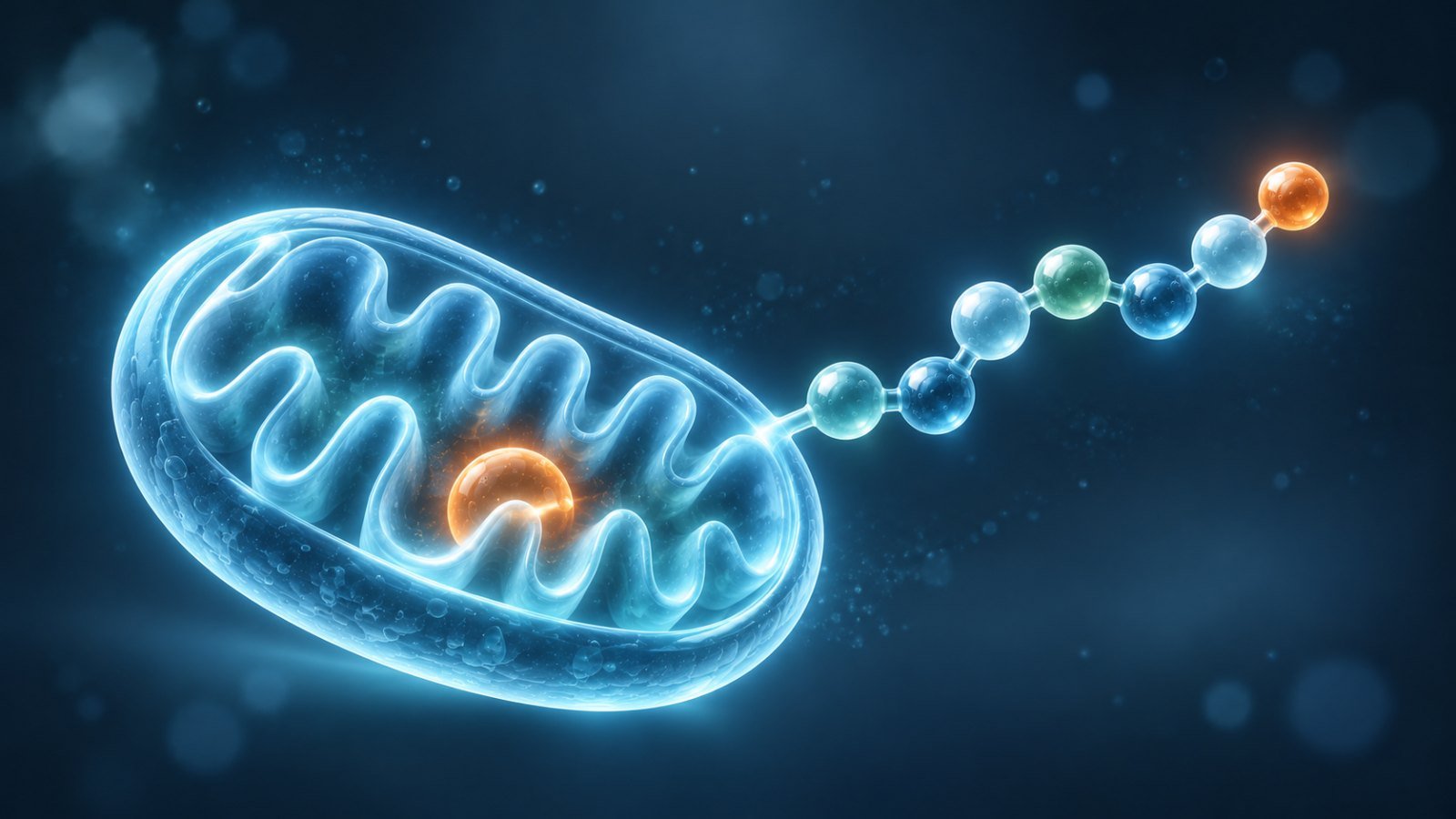
This guide explains each group, what has been published about the best-known members, and where the evidence stops. For laboratory research use only.
Three meanings of “mitochondrial peptide”
| Group | Examples | What they are |
|---|---|---|
| Mitochondrial-derived peptides | Humanin, MOTS-c, SHLP1 to SHLP6 | Natural peptides encoded by short open reading frames in mitochondrial DNA |
| Mitochondria-targeted peptides | SS-31 (elamipretide) | Synthetic peptides designed to accumulate at the inner mitochondrial membrane |
| Non-peptide compounds | NAD+, SLU-PP-332 | A coenzyme and a small molecule, studied for effects on mitochondrial metabolism and gene programs |
Mitochondrial-derived peptides
Human mitochondrial DNA is a circle of 16,569 base pairs. For two decades after it was sequenced in 1981 it was understood to carry 37 genes: 13 proteins of the respiratory chain, 22 transfer RNAs and 2 ribosomal RNAs. The mitochondrial-derived peptides were found later, hidden inside the two ribosomal RNA genes.
Humanin
Humanin was reported in 2001 by Hashimoto and colleagues, who were screening for genes that protected cultured neurons from insults associated with Alzheimer’s disease. It is encoded within the 16S ribosomal RNA gene and is 24 amino acids long, or 21 if translated inside the mitochondrion. It has since been studied mainly in cell-survival models.
MOTS-c
MOTS-c, a 16-amino-acid peptide encoded within the 12S ribosomal RNA gene, was described in 2015 by Lee and colleagues. The published work covers AMPK signaling, the folate cycle, movement of the peptide into the nucleus under metabolic stress, and exercise models in mice. Its sequence can only be read using the standard genetic code, which indicates that it is translated in the cytoplasm, not inside the mitochondrion. The detail is in MOTS-c in the research literature.
The small humanin-like peptides
Six further peptides, SHLP1 to SHLP6, were reported in 2016 from the same 16S region that encodes humanin. They are between 20 and 38 amino acids long. SHLP2 and SHLP3 have received the most study. More candidates have been proposed since.
Mitochondria-targeted peptides
These are not natural products. The best characterized is SS-31, also called elamipretide, a four-residue synthetic peptide with alternating aromatic and basic residues. It concentrates at the inner mitochondrial membrane, where it binds the lipid cardiolipin. It is mentioned here because it appears in the same discussions as MOTS-c. Quantum Peptides does not supply it.
Compounds that are not peptides
Two compounds in our catalog are often grouped with mitochondrial peptides and are neither.
- NAD+ is a dinucleotide coenzyme that carries electrons in the reactions feeding the respiratory chain, and is consumed by sirtuins, PARPs and CD38. See NAD+ in the research literature.
- SLU-PP-332 is a small synthetic agonist of the estrogen-related receptors, nuclear receptors that regulate genes for mitochondrial biogenesis and fatty-acid oxidation. Its literature is recent and comes largely from one group’s mouse and cell work. See SLU-PP-332 in the research literature.
The difference is practical. A coenzyme, a small molecule and a peptide dissolve differently, are tested differently and degrade differently, as explained in peptide vs protein vs amino acid.
What the literature has not shown
Most findings on mitochondrial-derived peptides come from cultured cells and rodents. Several basic questions remain open:
- Where they are made. For humanin, it is still not settled whether translation happens in the mitochondrion or the cytoplasm.
- How they are measured. Reported circulating levels depend heavily on the assay, and results differ between laboratories.
- Whether nuclear copies contribute. The nuclear genome contains fragments copied from mitochondrial DNA, which complicates the assignment of a peptide to its gene.
- Receptors. Binding partners have been proposed for humanin; for MOTS-c no cell-surface receptor has been established.
Associations between these peptides and aging or metabolism in human samples are correlations. They do not show cause.
What Quantum Peptides supplies
Of the compounds in this guide we supply MOTS-c 10 mg and NAD+ 1000 mg as lyophilized vials, and SLU-PP-332 1 mg capsules. Each is a different class of compound with its own handling requirements, described in its overview.
Frequently asked questions
What are mitochondrial peptides?
Strictly, peptides encoded in mitochondrial DNA: humanin, MOTS-c and the SHLPs. The phrase is also used loosely for synthetic peptides that target mitochondria and for non-peptide compounds studied in mitochondrial research.
Is MOTS-c made in the mitochondria?
It is encoded in mitochondrial DNA, but its sequence can only be read with the standard genetic code, which indicates translation in the cytoplasm.
Is NAD+ a peptide?
No. NAD+ is a dinucleotide coenzyme. It contains no amino acids.
Is SLU-PP-332 a peptide?
No. It is a small synthetic molecule that activates the estrogen-related receptors.
How many mitochondrial-derived peptides are known?
Eight are well described: humanin, MOTS-c and SHLP1 to SHLP6. Others have been proposed.
References
- Anderson S, Bankier AT, Barrell BG, et al. Sequence and organization of the human mitochondrial genome. Nature. 1981. PMID 7219534
- Hashimoto Y, Niikura T, Tajima H, et al. A rescue factor abolishing neuronal cell death by a wide spectrum of familial Alzheimer’s disease genes and Aβ. Proceedings of the National Academy of Sciences. 2001. PMID 11371646
- Lee C, Zeng J, Drew BG, et al. The mitochondrial-derived peptide MOTS-c promotes metabolic homeostasis and reduces obesity and insulin resistance. Cell Metabolism. 2015. PMID 25738459
- Cobb LJ, Lee C, Xiao J, et al. Naturally occurring mitochondrial-derived peptides are age-dependent regulators of apoptosis, insulin sensitivity, and inflammatory markers. Aging. 2016. PMID 27070352
- Kim SJ, Xiao J, Wan J, Cohen P, Yen K. Mitochondrially derived peptides as novel regulators of metabolism. Journal of Physiology. 2017. PMID 28574175
- Birk AV, Liu S, Soong Y, et al. The mitochondrial-targeted compound SS-31 re-energizes ischemic mitochondria by interacting with cardiolipin. Journal of the American Society of Nephrology. 2013. PMID 23813215
- Billon C, Sitaula S, Banerjee S, et al. Synthetic ERRα/β/γ agonist induces an ERRα-dependent acute aerobic exercise response and enhances exercise capacity. ACS Chemical Biology. 2023. PMID 36988910
Quantum Peptides supplies lyophilized research peptides for in-vitro and preclinical laboratory research only. Products are not for human or veterinary use. This guide summarizes published literature and is not guidance on administration of any kind.